


The Light That Was First
On the symbolism of light in the Bible and art that is born from silence
“Let there be light.”(Genesis 1:3)
Before shapes appeared.
Before things were given names.
Before the world received its boundaries.
There was light.
Not as decoration.
Not as something whose only purpose was to dispel darkness.
Light appears at the very beginning of the story of creation.
And perhaps that is why, for so long, we have tried to paint it.
Not only because it is beautiful.
Perhaps because we recognise in it something we cannot fully name.
In the Bible, light is never merely a physical phenomenon.
It can mean presence, knowledge, life, hope, a path.
It is the opposite of darkness, but it does not always deny it.
Sometimes light appears precisely where there was darkness before.
In the Book of Genesis,
God's first word concerning the creation of light sounds like the beginning of order:
“Let there be light.”
And many centuries later, in the Gospel of John, another light appears:
“In Him was life, and that life was the light of humanity. And the light shines in the darkness, and the darkness has not overcome it.” (John 1:4–5)
This is no longer only a light that can be seen.
It is a light that can be recognised.
Perhaps this is why light appears so often in art.
An artist can paint colour.
Can paint space.
Can try to capture movement, a body, a landscape, an object.
But when an artist tries to paint light,
something much more elusive begins to be touched.
Because light itself has no shape.
It needs something upon which it can rest.
Walls. A face. Water. Mist. Matter.
Or a canvas.
And this is where, for me,
an extraordinary encounter between light and painting begins.
Some paintings do not begin with form.
There is no idea first:
“I am going to paint this.”
Sometimes they begin with a feeling.
With colour.
With silence.
With something that cannot yet be named.
The hand touches the canvas,
and the painting begins to appear slowly
not as a ready-made answer, but as a trace of searching.
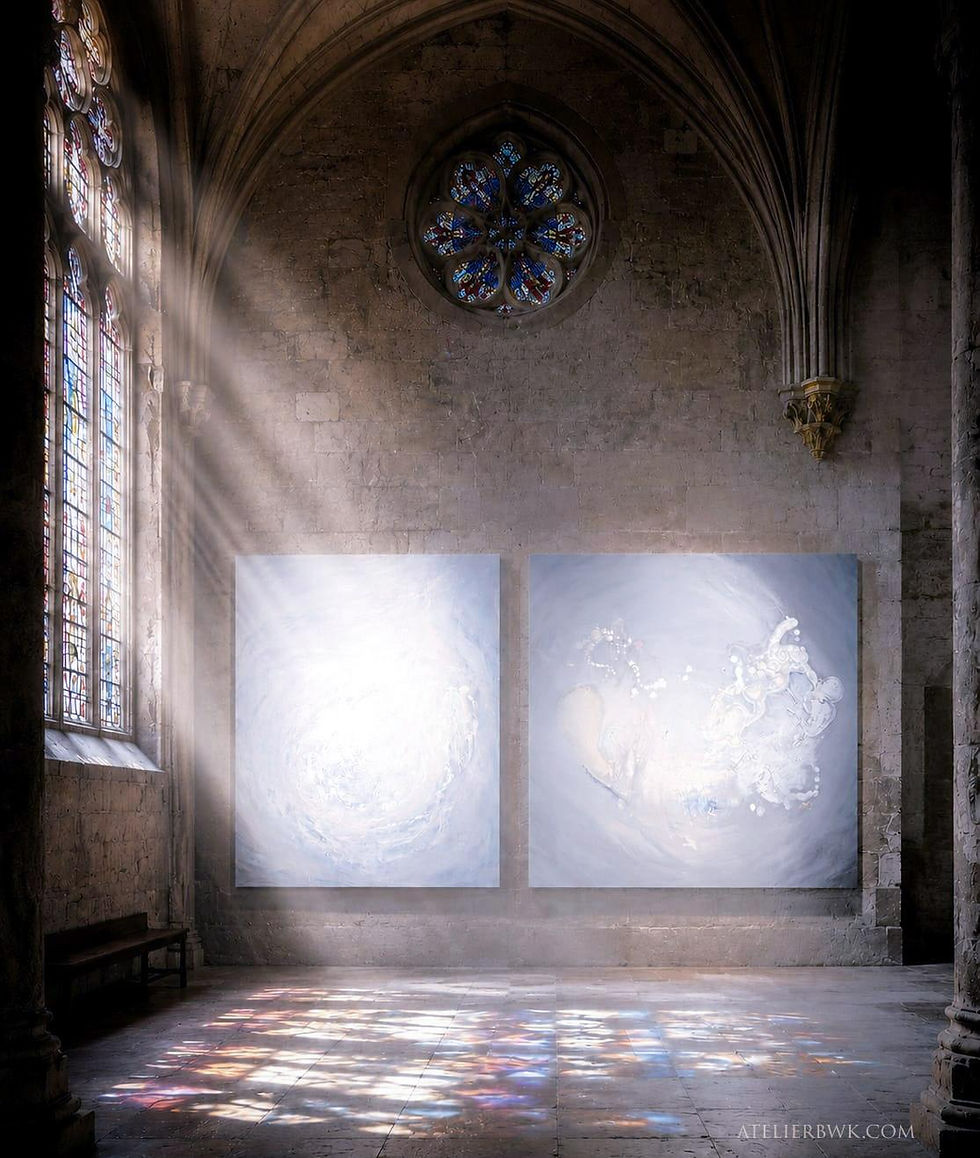
This is how part of the painting of Atelier BWK comes into being.
Intuitive, haptic painting, rooted in touch and presence.
I do not always try to tell you what you should see in a painting.
I am more interested in what you may feel when you look at it.
In this sense, abstraction is, for me, more than a departure from depicting reality.
It is a space.
It allows light to no longer be merely light upon an object.
It allows it to become an experience.
Sometimes almost silence.
Sometimes a memory.
Sometimes something that feels like a breath.
That is why a painting may not have one single story.
It may have as many stories as there are people who stand before it.
And perhaps that is when art begins to live its own life.
In the Bible, light leads.
“The Lord is my light and my salvation” — we read in Psalm 27.
Light here does not mean brightness alone.
It also means trust.
A path.
A presence amidst what we do not yet understand.
This is deeply close to what painting means to me.
I do not always know where a painting is leading when I begin to create it.
But I am learning to trust what appears before me.

One layer.
Then another.
Sometimes the movement of a hand.
Sometimes stillness.
Sometimes the need to leave an empty space.
Because emptiness can also be part of a painting.
Just as darkness is needed for light to be noticed.
Perhaps this is why Via Lucis came into being.
The way of light.
Not as an illustration of a biblical story,
but as an attempt to touch what light may mean to a human being.
And later came ABUN - an even quieter space.
A place where a painting does not have to explain anything.
It may simply be.
Like a breath.
Like the moment before a word.
Like light entering through a half-open curtain in the morning.
I sometimes think that modern human beings have an enormous need for light.
And at the same time, we live in a world that speaks almost constantly.
Screens.
Notifications.
Information.
Images.
Opinions.
Sounds.
Another message.
Another thing that needs to be seen.
Another thing that needs an answer.
Perhaps this is why we increasingly need places
where nothing has to happen.
Places where we can simply pause our gaze.
Our breath.
Our thoughts.
And ourselves.
Art does not always have to shout.
It does not always have to explain.
It does not always have to be immediately understood.
Sometimes its most important role is
to create a space in which a person can hear something of their own.
That is why I believe a painting can be more than an object.
It can be a presence.
It can be an encounter.
It can be silence arriving when all the other voices fall quiet for a moment.
The light was first.
But perhaps it was not first only because it illuminated the darkness.
Perhaps it was first because it made seeing possible.
And perhaps that is why we are still following it.
In the Bible.
In art.
In another person.
Within ourselves.
Searching not always for answers.
Sometimes only for that one moment when something suddenly becomes a little clearer.
Not outside.
Within us.

I am not calling you.
I simply am.
I leave a colorful trace…
so that something within you may find its way.
Beata | Haptic painting. Atelier BWK
Comments